The King of Zakopane Peaks
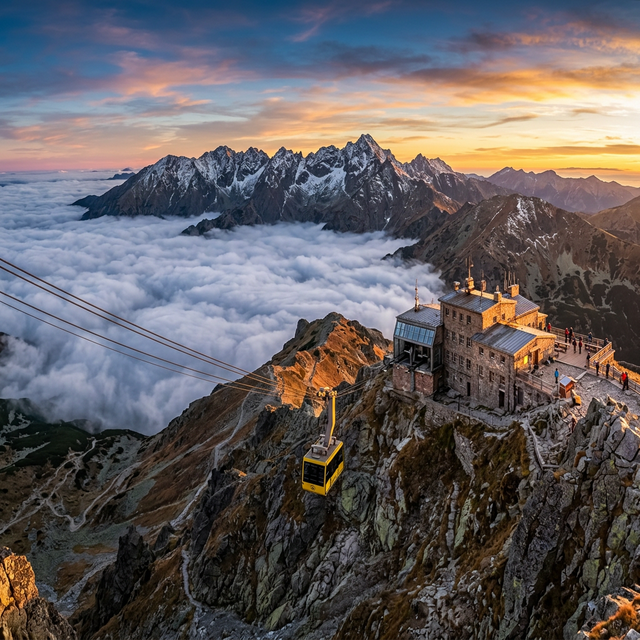
Standing on the summit of Kasprowy Wierch (1,987 meters) is the quintessential Zakopane experience—allowing everyone to touch the clouds regardless of fitness.
Kasprowy Wierch is more than just a mountain; it is a national symbol of Polish high-altitude ambition. Located exactly on the border between Poland and Slovakia, its summit offers a 360-degree panorama that encompasses both the jagged, dark granite of the High Tatras to the east and the rolling, green limestone ridges of the Western Tatras to the west. Whether you arrive by the historic cable car or via a strenuous 3-hour hike, the feeling of standing above the world is unparalleled.
1. History: The 1935 Alpine Miracle
The story of Kasprowy Wierch is inseparable from its cable car (*Kolej Linowa*). In an era of limited technology, the cable car was built in a record-breaking **227 days** between 1935 and 1936. Hundreds of workers lived in temporary high-altitude camps, hauling iron cables and concrete on their backs during one of the harshest winters in Polish history. It was a project intended to prove Poland's modern engineering prowess to the rest of Europe. Today, the system is completely modernized with state-of-the-art Swiss cabins, but the original stone station buildings remain as monuments to that heroic pre-war era.
2. Meteorology: The Highest Observatory
Perched just a few meters from the cable car station is the **High-Mountain Meteorological Observatory**. Built in 1938, it is the highest inhabited building in Poland. The scientists who live here work in some of the most extreme conditions in Europe, recording winds that can exceed 150 km/h and snow depths of several meters. For tourists, the observatory provides the most accurate "live" weather data for the entire Tatra range, which is critical for the safety of hikers planning more technical routes along the ridges.
Kasprowy Wierch is a high-altitude sanctuary that offers a unique environment for spiritual reflection.
- Salah Above the Clouds: The summit area is wide and features several flat granite slabs. If you walk 5 minutes toward the **Sucha Przełęcz** (the pass toward Slovakia), you will find quiet, clean, and secluded spots to perform Salah with a view that spans two countries.
- High-Altitude Dining: The restaurant inside the station building is the highest in Poland. While the menu includes meat, we highly recommend the **Tomato Soup** or the **Cabbage Soup** (ensure it's without 'boczek'). Their hot fruit strudels are a perfect energy boost for the cold summit air.
- Thermal Wudhu Tip: There are modern, heated restrooms inside the station building. This is the only place in the High Tatras where you can perform Wudhu with warm water—a vital luxury given the summit temperature can be 15°C lower than Zakopane.
Tickets & Tours
3. Geology: The Granite-Metamorphism Boundary
Geologically, Kasprowy Wierch sits at a fascinating transition point. The summit itself is composed of metamorphic granite, which is harder and darker than the limestone found in the nearby Giewont. This provides the mountain with its jagged, dramatic appearance. The erosion patterns here have created wide, bowl-shaped valleys (*Kocioł Gąsienicowy* and *Kocioł Goryczkowy*) that act as natural amphitheaters for both hikers in summer and skiers in winter.
4. Skiing Heritage: The Heart of Winter Sports
For Poles, Kasprowy is the "Holy Grail" of skiing. It is the only place in the country with truly Alpine-style ski runs. The two main slopes, Goryczkowa and Gąsienicowa, are primarily dependent on natural snow (no artificial snowmaking is allowed here due to National Park regulations). Skiing down from the summit under the moonlight is a tradition that dates back to the early 1900s, and the nostalgic chairlifts at Goryczkowa still offer a glimpse into the classic era of winter sports.
5. Wildlife: Guardians of the Peak
Despite the high volume of cable car tourists, the summit is a territory for the **Tatra Chamois** (*Kozica*). They can often be seen just a few dozen meters from the station platforms, grazing on the hardy alpine grasses. You may also hear the high-pitched whistle of the **Alpine Marmot** (*Świstak*) echoing from the rock debris below the observatory. These animals are strictly protected, and their presence at such a busy peak is a testament to the successful conservation efforts of the TPN (Tatra National Park).
6. Navigation: The Choice of Three Descents
If you choose not to take the cable car back down, you have three iconic options:
- Hala Gąsienicowa (Yellow Trail): A 2-hour descent into a valley famous for its glacial lakes and stone shelters.
- Czerwone Wierchy (Red Ridge): A high-level ridge walk toward the west that offers continuous panoramic views.
- Kuźnice via Myślenickie Turnie: The most direct path down, following the path of the cable car through the forest.
The Local Side
Most people take the cable car both ways, missing the best part of the mountain. My absolute favorite thing to do is buy a one-way ticket UP, enjoy the peak, and then hike down via the **Hala Gąsienicowa** yellow trail. You save your knees from the initial brutal climb, but you get all the incredible sweeping views on the way down, passing through the beautiful glacial lakes area right as the afternoon sun hits it.
Kasprowy Wierch FAQ
How high is Kasprowy Wierch?
Kasprowy Wierch stands at 1,987 metres (6,519 ft), on the border between Poland and Slovakia. It is one of the most accessible high peaks in the Tatras because a cable car carries you almost to the summit.
How much does the Kasprowy Wierch cable car cost in 2026?
A return ticket is typically around 100–130 PLN for adults in high season, with discounts for children and one-way options. Prices and time slots change seasonally, and tickets sell out in peak periods. From Zakopane, book a timed return cable car ticket with transport to Kuźnice. From Kraków, compare the private Tatra hiking day with the cable car included.
Can you hike up Kasprowy Wierch instead of taking the cable car?
Yes. The walk up from Kuźnice via Myślenickie Turnie takes about 3–4 hours and is a steady, strenuous climb. Many visitors prefer to ride the cable car up and hike down via the Hala Gąsienicowa yellow trail to save their knees while keeping the views.
Is the Kasprowy Wierch cable car open in winter?
Yes, the cable car runs year-round, weather permitting, and Kasprowy is Poland's premier Alpine ski area in winter. Operations pause during high winds or maintenance windows, so confirm availability for your date before travelling.