The Crown Jewel of the Tatra Mountains
Morskie Oko (Eye of the Sea) is not just a lake; it is a legend. This glacial lake sits deep within the High Tatras beneath Rysy, Poland's highest mountain. Most visitors reach the trailhead by car or shuttle bus, but the easiest option is to pre-book a Morskie Oko transfer with the Tatra Park ticket included and avoid arranging a separate parking reservation.
1. History: The Duel for the "Eye of the Sea"
Morskie Oko was once the center of an intense international legal battle. In the late 19th century, a dispute broke out between Galicia (under the Austrian Empire) and Hungary over the exact placement of the border in the High Tatras. Both sides claimed the lake. The conflict was finally resolved in 1902 by a special international tribunal in Graz, which ruled in favor of Galicia (and thus, modern-day Poland). This legendary legal victory is celebrated as a moment of national pride. The historic wooden shelter, built shortly after the ruling, stands as a monument to the endurance of those who protected this "Crowned Jewel" for future generations.
2. Geology: The Glacial Masterpiece
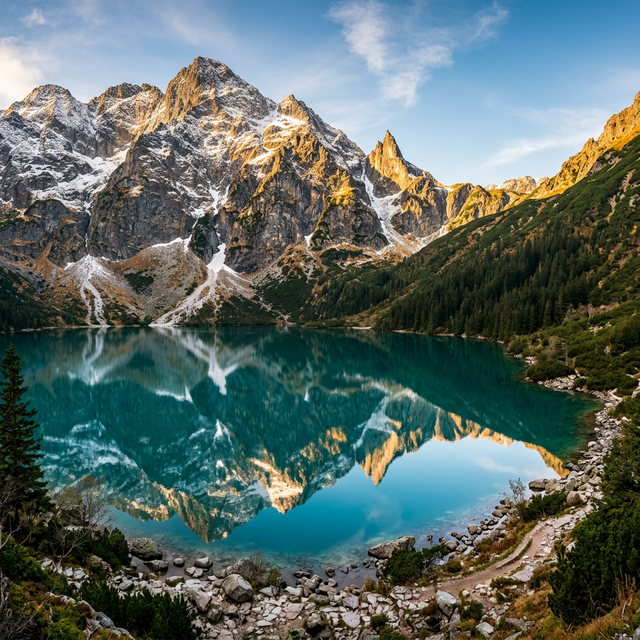
Geologically, Morskie Oko is a "glacial trough" lake. Thousands of years ago, a massive valley glacier carved a deep hole into the hard granite of the High Tatras. As the ice melted, it left behind the deep basin we see today. Unlike the limestone valleys of the West Tatras, Morskie Oko is surrounded by jagged, unyielding granite. Looming over the western shore is the **Mnich** (The Monk)—a pointed granite monolith that is considered the most iconic climbing peak in Poland. Its sharp needle-like silhouette reflects perfectly in the surface of the water, creating the "double peak" effect famous in Tatra photography.
Vital Halal Logistics
Morskie Oko is a high-traffic destination, but it offers profound spiritual moments if you know where to look.
- Halal Food Strategy: While the shelter serves many meat dishes, their **Szarlotka** (Hot Apple Pie) and **Naleśniki** (pancakes) are vegetarian and exceptionally high quality. For a protein boost, we recommend bringing your own Halal-certified jerky or tinned tuna, which can be eaten alongside the shelter's fresh bread and salads.
- The "Quiet Side" for Salah: The terrace of the shelter is too crowded for prayer. Instead, walk down to the lake shore and take the path to the **left** (towards the Rysy trail). About 15 minutes in, the crowds disappear. There are several flat granite "tables" near the water's edge where you can perform Salah in total silence with the mountains reflecting in the lake as your backdrop.
- Wudhu from the Source: The water of Morskie Oko is crystal clear and snow-fed. If you find a quiet spot on the shore, the water is perfectly suitable and spiritually uplifting for Wudhu. Be warned: even in mid-summer, the water temperature rarely exceeds 12°C!
Tickets & Tours
3. Wildlife: High-Altitude Residents
The granite walls around the lake are home to the **Alpine Newt** (*Traszka górska*), which can sometimes be seen in the shallower, sun-warmed pools at the lake's edge. Because the lake is so deep and sheltered, it also supports a unique population of **Brown Trout**, making it one of the few high-altitude lakes with a significant fish population. High above, on the rocky scree of Rysy, you can often spot the **Tatra Marmot** (*Świstak*) basking on flat stones in the late morning sun.
4. Want More Adventure? Hike to Czarny Staw
If reaching Morskie Oko isn't enough, you can hike up to the second lake, **Czarny Staw pod Rysami** (Black Pond under Rysy). The trail starts right at Morskie Oko, circles around the left side of the lake, and climbs steeply for about 45 minutes over massive stone stairs. The view from Czarny Staw looking *down* at Morskie Oko is world-class and highly recommended for travelers without strollers.
Want to go deeper into the High Tatras safely? Consider a 2-day guided Tatra Mountains hiking tour. Check the route, difficulty, inclusions and cancellation terms for your date before booking.
5. The Legend of "The Eye of the Sea"
6. Seasonal Magic: The Winter Crossing
In winter, Morskie Oko becomes a demanding mountain objective. Do not assume the frozen lake is safe to cross; avalanche and ice conditions can change quickly. Check current Tatra safety information before leaving and stay on the marked route. For a more structured mountain visit, compare a guided Tatra Mountains hiking tour and confirm that its seasonal route matches your date.
Pro-Preparation Checklist
Even on the "easy" paved road, the high mountains command respect. Be prepared for sudden changes in conditions:
- Layered Clothing: The temperature at the lake is often 5-10°C cooler than in Zakopane.
- Proper Footwear: Comfortable, well-cushioned walking shoes are a must for the 18km round trip.
- Cash: The shelter and horse carriages often do not accept credit cards due to poor signal.
- Booking: Parking must be booked in advance during busy periods, or avoid the stress and pre-book a direct trailhead transfer that includes the Tatra Park ticket.
Local Secret
Everyone stops at the main wooden shelter for lunch, but here is my pro tip: bypass the main kiosk and walk to the **Old Shelter** (Stare Schronisko) located just 20 meters behind the new one. It's the oldest hut in the Tatras and feels much more authentic. If you want the most "halal-friendly" mountain air, walk past the shelter 500 meters towards the **Dolina za Mnichem** trail. Almost no one goes there, and the quiet is profound—perfect for a peaceful late-afternoon prayer.
Written and reviewed by the ZakopaneHalal editorial team
Halal travel desk
How we verifyZakopaneHalal is an independent guide to Zakopane and the Polish Tatras for Muslim travellers. Restaurant listings are checked against the venue directly — meat sourcing, kitchen practice and whether the kitchen handles pork — and re-checked when ownership or menus change. Trail and transport guidance is based on published Tatra National Park information and on the current timetables and prices, which we revisit each season. Where we are not certain of something, we say so on the page rather than guess.