A Limestone Masterpiece
Dolina Kościeliska is widely considered the most beautiful valley in the Polish Tatras, a place where geography, history, and folklore intertwine.
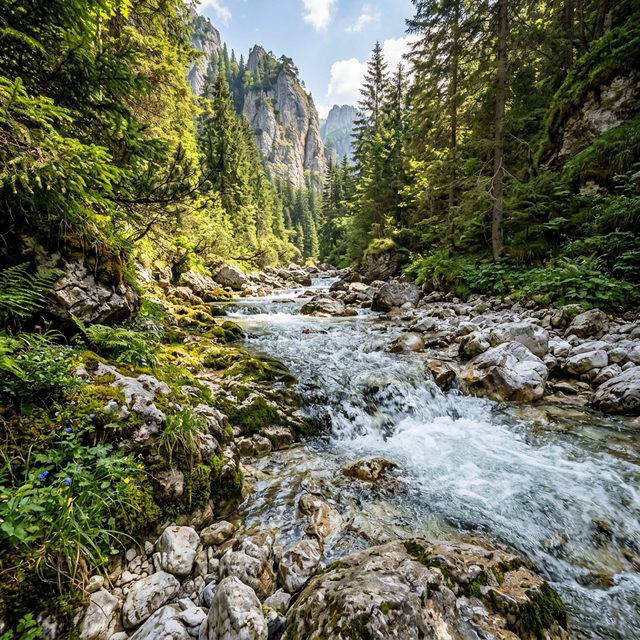
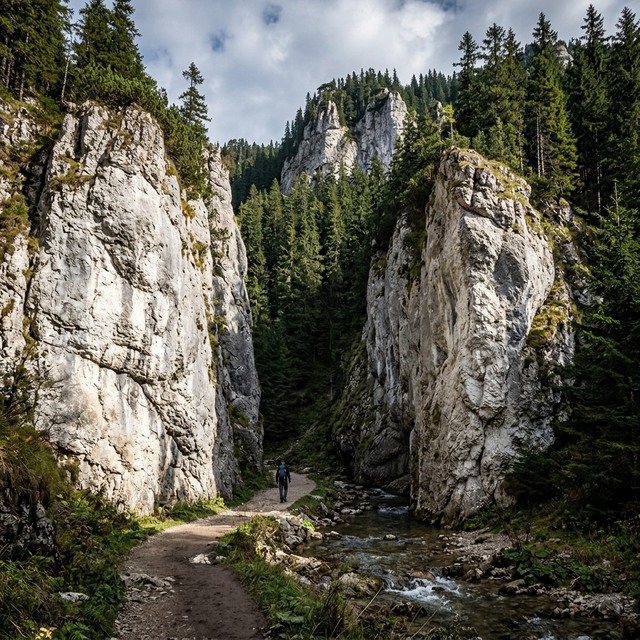
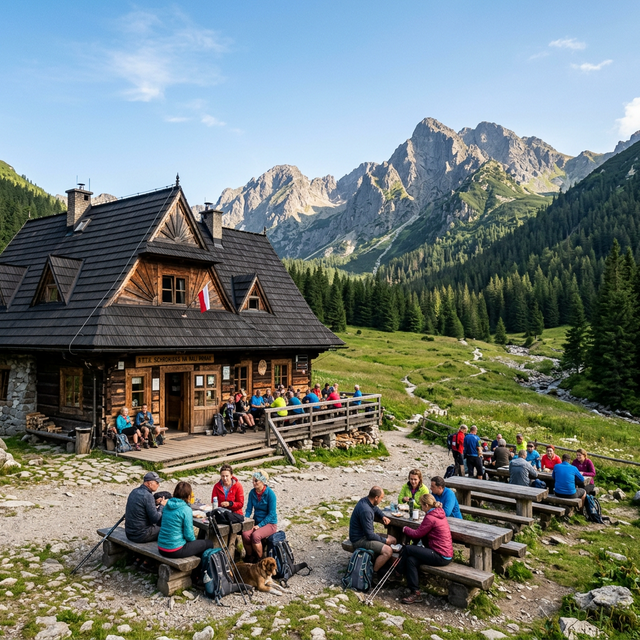
Unlike the jagged granite of the High Tatras, this valley is carved out of white limestone, creating a softer but more intricate landscape of dramatic gorges, rushing rivers, and a network of over 400 caves. The main path is a 6-kilometer gravel road that follows the crystal-clear **Kościeliski Stream** all the way to the Ornak Shelter at the valley's head.
1. History: The Cradle of Mining and Smuggling
Long before it was a tourist destination, Kościeliska was the industrial heart of the Tatras. From the 15th century, it was a center for mining iron, silver, and lead. The name "Kiry" (the valley entrance) actually refers to the sound of hammers in the local forges. In the 19th century, the valley became a legendary hideout for smugglers and highlander brigands (*Zbójnicy*), who used the labyrinthine caves to evade the border guards. Today, you can still see the remains of the old smelting furnace near the entrance, a quiet reminder of the valley’s gritty, industrial past.
2. Geology: The Karst "Stone Gates"
The valley is divided by three spectacular "gates" (*Bramy*), where the limestone walls close in so tightly that only the river and the road can pass through. The **Niżnia Brama Kantaka** is the first encounter, followed by the **Brama Kraszewskiego** and the **Wyżnia Brama Kiry**. These formations are the result of "Karst" erosion, where acidic rainwater slowly dissolves the soft limestone over millions of years, creating the vertical white cliffs and deep underground drainage systems that make this valley unique in Europe.
Kościeliska is perfectly suited for Muslim travelers due to its high level of privacy and natural purity.
- Wudhu from the Stream: The Kościeliski Stream flows directly alongside the main path. Its limestone-filtered water is incredibly clean and geologically pure for Wudhu. For the best privacy, stop at the "Polana Pisana" meadow.
- Salah in the High Meadows: The massive **Polana Pisana** (midway) and the **Mała Polana Ornacza** (near the shelter) offer vast, clean grassy areas. Walk 50 meters off the main path toward the tree line to find total seclusion for Dhuhr and Asr prayers.
- Halal-Friendly Ornak Shelter: The Ornak shelter kitchen specializes in vegetarian Polish classics. Their **Tatra Apple Pie (Szarlotka)** is made with local butter and is vegetarian-safe. Avoid any soups containing "boczek" (bacon)—stick to the tomato or mushroom options.
3. Wąwóz Kraków: The Limestone Cathedral
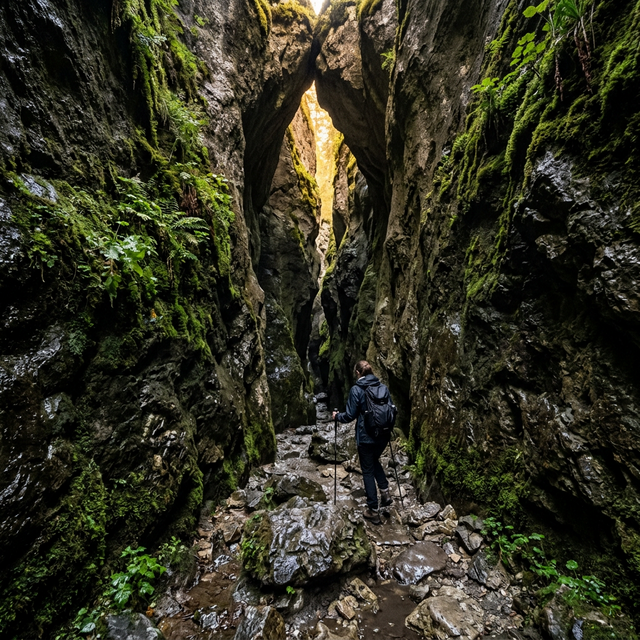
Often overlooked by tourists, the **Wąwóz Kraków** (Kraków Gorge) is perhaps the most magical side-trail in the Tatras. Branching off to the left midway through the valley, this narrow canyon features 100-meter-high vertical walls that block out the sun, creating a temperature drop of several degrees. At the end of the gorge lies the "Dragon’s Den" (*Smocza Jama*), a short but thrilling cave that can be climbed with the help of metal chains and ladders. It feels less like Poland and more like a hidden canyon in the American Southwest or Jordan.
4. Caving: From Mroźna to Mylna
Kościeliska is the capital of Polish caving. There are three distinct levels of experience:
- Jaskinia Mroźna (The Frosty Cave): The only lit cave in the park. It is safe for children and elderly travelers, featuring a well-maintained path and a constant temperature of 6°C year-round.
- Jaskinia Mylna (The Labyrinth): For the brave. This cave is unlit and requires a powerful headlamp. It is a one-way walk through a series of narrow tunnels and chambers. You must follow the painted markers on the walls—if you lose them, you are truly in a labyrinth.
- Jaskinia Raptawicka: Reached by a steep climb on a vertical ladder, it offers a massive, open "room" that feels more like an underground temple than a cave.
5. Wildlife: The Golden Eagle
The limestone cliffs of Kościeliska are a preferred nesting ground for the **Golden Eagle** (*Orzeł przedni*). If you bring binoculars and look at the highest ledges of the Saturn or Pisana peaks, you may see these massive raptors circling on the thermals. The valley floor is also home to the **Lesser Spotted Woodpecker** and a variety of colorful mountain butterflies that thrive in the nutrient-rich limestone soil.
6. Winter Tradition: The Kulig
In winter, Kościeliska transforms into a snowy wonderland. Since the main road is flat, it is the primary location for the **Kulig**—a traditional Goral horse-drawn sleigh ride. Wrapped in sheepskin blankets and carrying torches, tourists are taken to the Ornak shelter through paths lit by the moon. It is the most romantic and family-friendly winter experience in Zakopane, allowing you to see the valley without the physical exertion of hiking through deep snow.
Local Secret
Everyone goes to the Ornak shelter, but if you want to see something truly unique, take the short 30-minute side path to the **Smreczyński Staw** lake. It's a dark, stagnant lake surrounded by spruce forest, and unlike Morskie Oko, it feels eerie and primitive. My second secret: if you visit in early June, the meadows near the **Pisana** rock are filled with **Globe Flowers** (Pełnik Europejski)—massive yellow blossoms that look like lemons growing on stalks. It's a much more private alternative to the April crocus rush.
Kościeliska Valley FAQ
How long is the Kościeliska Valley walk?
The main valley walk to the Ornak shelter and back is about 12 km round trip, taking roughly 3.5 hours at an easy pace along a flat, wide gravel road. You can turn back at any point, making it one of the most flexible trails in the Tatras.
Is Kościeliska Valley suitable for strollers and seniors?
Yes. The valley floor is a flat, well-maintained road with gentle gradients, making the lower sections very accessible for strollers, wheelchairs, and older walkers. Horse-drawn carriages also operate for those who prefer not to walk the full distance.
How do you get to Kościeliska Valley from Zakopane?
Take a PKS or private minibus (busik) from Zakopane's main bus station toward Kiry; the valley entrance at Kiry/Siwa Polana is about 20–25 minutes away. The Tatra National Park charges a small entry fee (around 9–12 PLN per adult), payable at the gate.
Is Kościeliska or Chochołowska Valley better?
Kościeliska is more dramatic, with limestone gorges and caves, while Chochołowska is longer and famous for spring crocuses. For a shorter, scenery-packed family walk, Kościeliska is the better choice.
Is Wąwóz Kraków in Krakow city?
No. Wąwóz Kraków, also searched as Wawoz Krakow or Krakow Gorge, is a limestone side canyon in Kościeliska Valley near Zakopane. It is a Tatra hiking attraction, not a neighbourhood or gorge inside Krakow city.