K raków is where almost every trip to southern Poland begins, and it is the one place in this region you can see properly on foot. The medieval core survived the war intact, everything worth seeing sits inside a twenty-minute walk, and unlike the mountains it works in any weather. This guide covers the city itself — not the day trips out of it, which have their own guide.
A word on what this page does and does not cover. Halal restaurants in Kraków are handled in detail in our Kraków halal food guide, and questions about prayer facilities, hijab and general safety are answered in is Kraków safe for Muslims. This one is about what to actually go and see, in what order, and how much time each thing really takes.
How the city is laid out
Kraków makes sense once you understand it as four zones on a north–south line, all walkable from one another.
The Old Town sits at the top, a near-perfect medieval grid wrapped in a ring of parkland called the Planty — the old city walls were pulled down in the 19th century and replaced with a green belt, which is why you can walk a complete circle around the historic core in about forty minutes. At its centre is the Main Square.
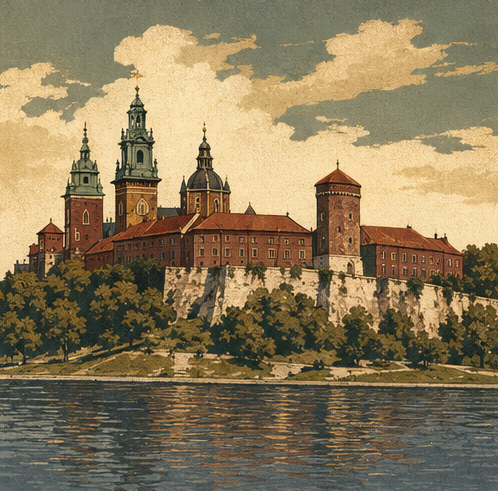
Wawel Hill is at the southern edge of the Old Town, ten minutes' walk from the square: the royal castle and cathedral on a limestone bluff above the river.
Kazimierz lies just south of Wawel, fifteen minutes further on. For five centuries this was Kraków's Jewish quarter; today it is the city's most atmospheric district, full of synagogues, courtyards and small cafés.
Podgórze is across the Vistula from Kazimierz. This is where the Nazis confined the ghetto in 1941, and where Schindler's Factory stands. It is the quietest of the four and the most sobering.
Everything in this guide is in one of those four. You will not need public transport for any of it, though taxis and ride-hailing are cheap if you have small children or someone who tires.
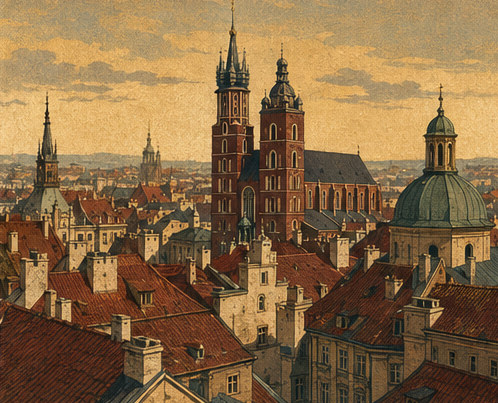
The Main Square and St Mary's Basilica
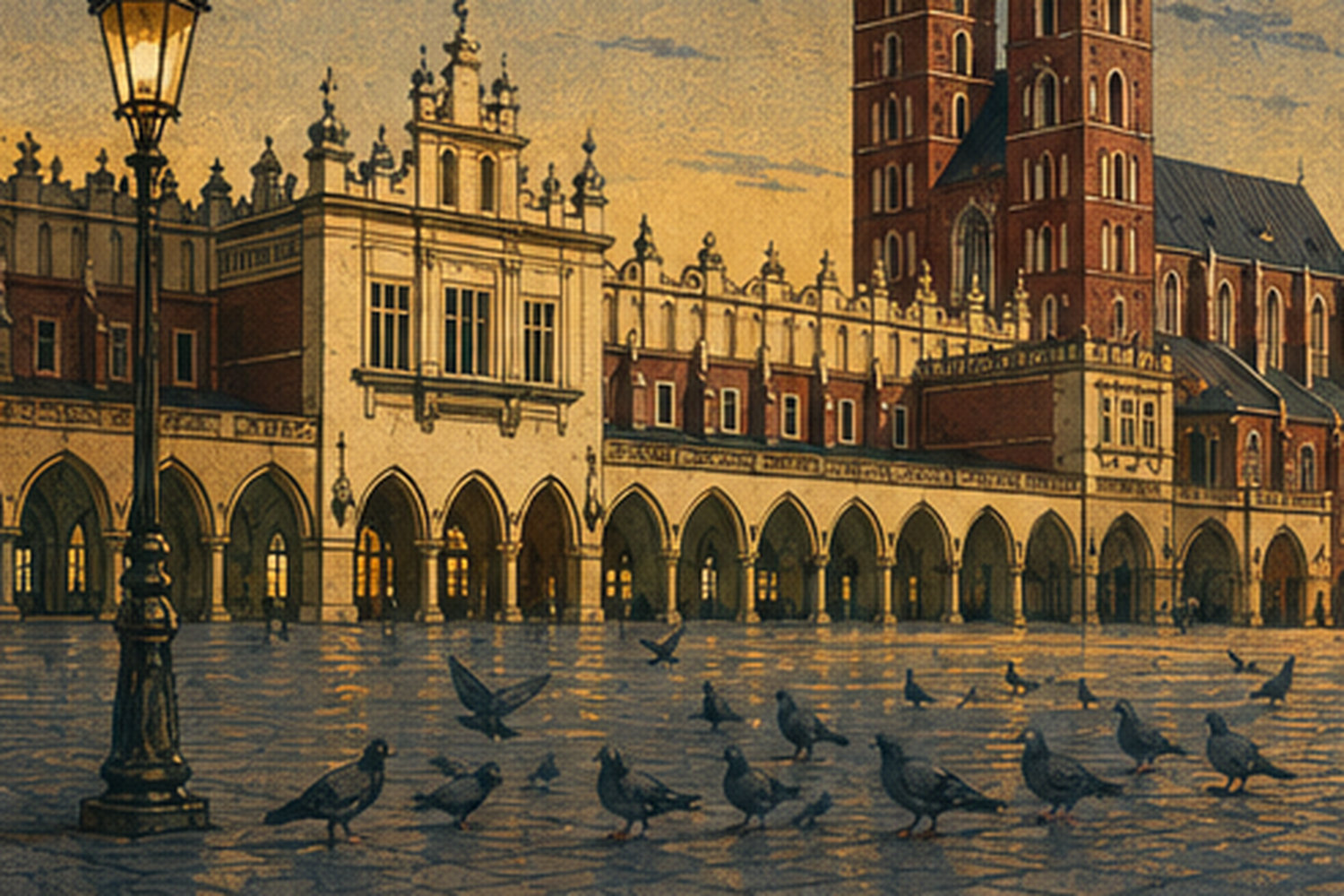
Rynek Główny is the largest medieval town square in Europe — roughly 200 metres on each side, laid out in 1257 and never rebuilt since. Standing in the middle of it is the Cloth Hall, a long Renaissance trading hall that has been a market for seven hundred years and still is: the ground floor is stalls selling amber, wood carving and highland crafts. Prices there are tourist prices, but the building is worth walking through regardless.
On the eastern side stands St Mary's Basilica, with its two mismatched brick towers. Every hour, on the hour, a trumpeter plays a short melody from the taller tower — the hejnał — and breaks off mid-phrase. The story goes that a medieval trumpeter was shot in the throat by a Tatar arrow while sounding the alarm, and the call has been cut short ever since in his memory. It is played four times, once to each point of the compass, and it is broadcast live on Polish national radio at noon. Standing in the square at the top of the hour costs nothing and is the single most Kraków thing you can do.
Inside, the basilica holds a carved wooden altarpiece by Veit Stoss, twelve metres high, which took a decade to make in the 15th century. Entry to the tourist section is ticketed and separate from the entrance used for worship. Do note that this is a working Catholic church: modest dress is expected, which for most Muslim visitors is not a change of anything, and photography rules are posted at the door.
Beneath the square is Rynek Underground, a museum built into the excavated medieval market level four metres down — original cobbles, foundations and trade routes, presented with a fair amount of projection and sound. It is genuinely good for children, and it is the obvious move when it rains.
Old Town, St Mary’s & Rynek Underground tour
If you would rather just walk the streets with someone who knows them, an English-language walking tour of the Old Town and Wawel covers both in one go and saves you queuing separately.
Wawel Castle and Cathedral
Wawel is the site Poles care about most. Kings were crowned and buried in the cathedral for five hundred years, the castle was the seat of the monarchy until the capital moved to Warsaw in 1596, and the hill has been continuously occupied since the Stone Age.
The practical thing to understand is that Wawel is not one ticket. The grounds are free to walk — you can climb the hill, circle the courtyards and look out over the Vistula without paying anything, and for many visitors that is enough. Inside, the State Rooms, the Royal Private Apartments, the Crown Treasury, the cathedral and the bell tower are all separately ticketed, with daily caps on numbers. In July and August the popular ones sell out by mid-morning.
If you only do one paid element, make it the State Rooms — the Renaissance interiors with the Flemish tapestries, and the famous coffered ceiling in the Envoys' Hall with carved human heads looking down from it. The Crown Treasury is smaller and more specialised.
Under the hill, at the riverside, is the Dragon's Den: a limestone cave with a fire-breathing bronze dragon outside that puffs actual flame every few minutes. It costs very little and children rate it above everything else in the city.
Skip-the-line Wawel Castle & Old Town tour
To compare what is available on a given date — the interiors that open vary by season and by day — the full Wawel listing is the place to look.
Kazimierz
Kazimierz was founded as a separate town in 1335 and became the centre of Jewish life in Poland for five hundred years. Before the war around 68,000 Jews lived in Kraków, most of them here. The community was almost entirely destroyed between 1941 and 1945, and the district fell derelict for decades afterwards.
What you see today is the physical fabric of that world, still standing: seven historic synagogues within a few streets of each other, the Old Synagogue from the 15th century — the oldest surviving in Poland — the Remuh Synagogue with its cemetery of tilted gravestones, and street after street of tenements with their original doorways. Some synagogues function as museums; a couple are active places of worship again.
Muslim visitors sometimes ask whether it is appropriate to visit. It plainly is: these are public museums and memorial sites that exist to be seen, and the district is one of the most visited parts of the city. The ordinary courtesies apply — heads covered where signs ask for it, quiet in the cemeteries, no photography where it is prohibited.
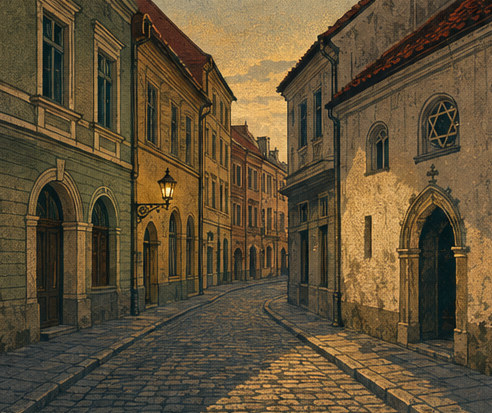
Kazimierz is also, incidentally, where a good share of Kraków's Middle Eastern and Turkish restaurants are, which makes it a practical place to end an afternoon. Details are in the halal food guide.
Kazimierz, Schindler’s Factory & Ghetto tour
Schindler's Factory and Podgórze
In March 1941 the German occupiers forced Kraków's remaining Jewish population across the river into a walled ghetto in Podgórze, an area of some sixteen streets. Most of those held there were murdered at Bełżec or at Płaszów camp on the city's edge; the ghetto was liquidated in March 1943.
Two sites mark it. Ghetto Heroes Square is now filled with seventy oversized bronze chairs, standing empty — a memorial referencing the furniture left scattered in the square after the deportations. Fragments of the ghetto wall survive nearby, built in a shape that deliberately echoed Jewish gravestones. Both are open, free, and outdoors.
Oskar Schindler's Enamel Factory, a few streets away, now houses a museum called Kraków under Nazi Occupation 1939–1945. It is not really about the film, and only partly about Schindler; it is a reconstruction of what the occupation did to the city, room by room, using apartments, shopfronts and tram interiors of the period. It is excellent and it is heavy going. Allow two hours, and go in the morning rather than at the end of a long day.
Tickets are limited and sell out. As with Auschwitz, note that the museum has quiet-conduct rules and that this is a memorial as much as an exhibition.
Schindler’s Factory tickets & tours
The Planty and the Vistula
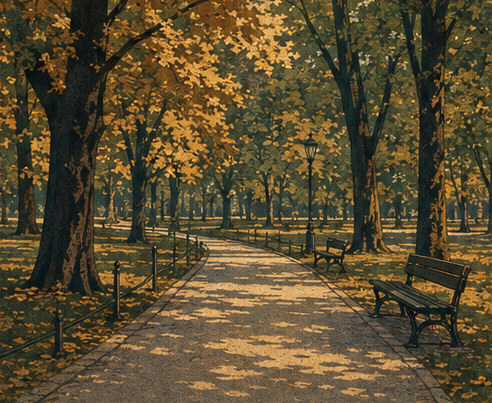
When you have had enough of museums, Kraków has two easy green options. The Planty is the park ring where the walls used to be — four kilometres of shaded path circling the Old Town, benches the whole way, and it is how locals actually cross the centre. A complete circuit takes under an hour at a stroll.
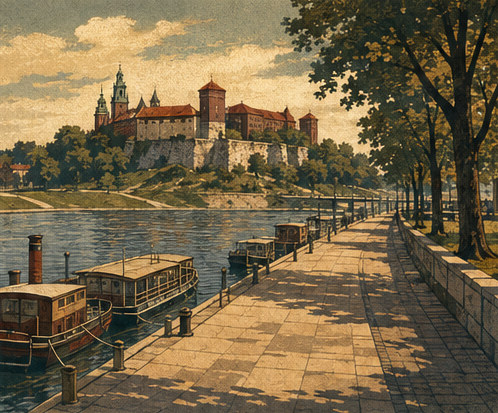
The Vistula embankment below Wawel is the other. Wide paved paths on both banks, long grassy stretches, and in summer a run of boats moored along the water. A short sightseeing cruise takes about forty-five minutes and gives you the castle from the angle it was designed to be seen from — useful if someone in the group cannot manage another day on their feet.
Vistula river sightseeing cruise
Practicalities for Muslim travellers
Food. Kraków is the one place in southern Poland with a real halal choice — Turkish, Arab, Lebanese and Indian, concentrated around Kazimierz and the streets north of the Old Town. That matters more than it sounds when you realise the rest of this region has almost none. The full list is in the Kraków halal food guide.
Prayer. Kraków has a Muslim community and prayer facilities, unlike the mountain towns further south. Current locations and opening arrangements are covered in our Kraków page rather than repeated here, because they change. Practically, the Old Town is small enough that you can return to your hotel between prayers without losing much of the day.
Timing. Poland's latitude makes summer days very long: in June, Isha can fall close to midnight and Fajr around three in the morning. Plan the heavy museum days for the middle of the day rather than the evening. Our prayer times page is calculated for local coordinates.
Dress and atmosphere. Kraków is a university city and a major tourist destination; hijab attracts no attention in the centre. Modest dress is also what the churches and synagogues ask of everyone, so you will be dressed correctly for every site on this list without thinking about it.
Walking. The Old Town is cobbled throughout — genuinely uneven medieval setts, not decorative paving. Wheeled luggage hates it, and so do thin soles. Factor that in if you are travelling with elderly relatives.
How long do you need
One day
Old Town + Wawel
Main Square and the hejnał, the Cloth Hall, then walk down to Wawel for the grounds and the State Rooms. Dinner in Kazimierz.
Two days
Add Kazimierz & Podgórze
A full second day for the synagogues, Ghetto Heroes Square and Schindler's Factory. Emotionally the heavier of the two days.
Three or more
Start going out
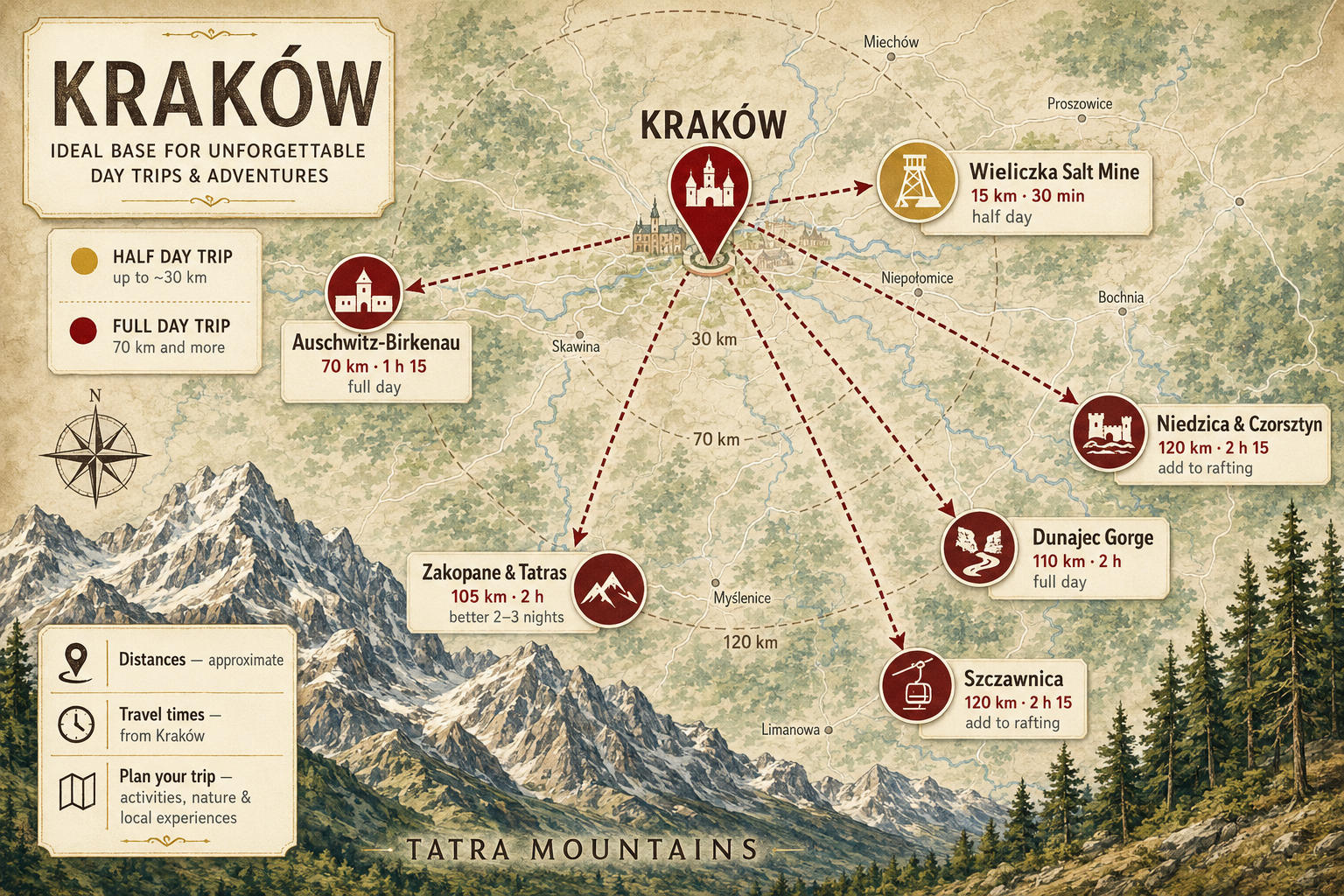
The city is covered. Use the extra days on Wieliczka, the Dunajec gorge or the Tatras.
Two days is the honest answer for Kraków itself. Anything beyond that is better spent heading south — and if you are going as far as the mountains, give Zakopane two or three nights rather than a rushed day trip. That is where the halal restaurants and the trails are, and it is the part of this trip most visitors say afterwards they wish they had given more time.