Islam is a small but historically rooted minority faith in Poland. While the country is overwhelmingly Roman Catholic, Muslims have lived on Polish lands for more than 600 years, the constitution guarantees freedom of religion, and a growing number of Muslim tourists now visit each year — including the families who come to the Tatra Mountains and Zakopane. This guide lays out the facts without exaggeration in either direction.
How Many Muslims Live in Poland?
There is no single official figure, but credible estimates put the Muslim population of Poland at somewhere between 25,000 and 45,000 people — roughly 0.1% of the national population of around 37 million. By any measure, Islam is one of the smaller minority faiths in the country.
That total is made up of several distinct groups: the historic Polish Tatar community, Polish converts, naturalised citizens of Middle Eastern and North African origin, international students, and a growing number of migrant workers. The Muslim population is concentrated in the larger cities — Warsaw, Gdańsk, Białystok, Wrocław, Łódź, and Kraków — rather than in rural areas or mountain towns.
Counting is complicated because Poland's census records religion only through voluntary self-identification, and many residents of Muslim background do not register a religion at all. This is why published figures vary so widely depending on the source and the year.
What Is the Main Religion in Poland?
Poland is one of the most religiously homogeneous countries in Europe. The 2021 national census recorded around 71% of the population as Roman Catholic, down from higher figures in previous decades. Religious observance — regular Mass attendance in particular — has been falling noticeably, especially among younger people in the cities.
After Catholicism, the next-largest religious groups are Orthodox Christians and various Protestant denominations, each well under a few percent. Islam, Judaism, and other faiths together make up a very small fraction of the population. For a Muslim traveller, the practical takeaway is simple: Poland is culturally Catholic, but it is also a modern EU country where personal religious practice is a private matter protected by law.
The Polish Tatars: 600 Years of Muslim History
Islam is not new to Poland. The Lipka Tatars — Turkic Muslims who settled on the lands of the Grand Duchy of Lithuania and the Polish-Lithuanian Commonwealth from around the 14th century — are one of the oldest continuous Muslim communities in Europe. They arrived as soldiers and settlers, were granted land and the right to practise their faith, and over the centuries became fully integrated Polish citizens while keeping their religion.
The Historic Wooden Mosques
In the north-eastern Podlaskie region, the villages of Kruszyniany and Bohoniki are home to historic wooden Tatar mosques and Muslim cemeteries (mizar) that are still in use today. They are protected heritage sites and a popular cultural day trip — tangible proof that a Muslim presence in Poland goes back centuries, not decades.
The community is represented by the Muslim Religious Union in Poland (Muzułmański Związek Religijny), formally recognised in 1925, making it one of the oldest officially registered Muslim organisations in Europe.
Are There Mosques in Poland?
Yes. While mosques are not a common sight, Poland has a number of active mosques and prayer centres:
- Warsaw — the Muslim Cultural Centre (Ośrodek Kultury Muzułmańskiej) serves as the main mosque and Islamic centre in the capital, alongside smaller prayer rooms.
- Gdańsk — a purpose-built mosque with a minaret, one of the first modern mosques constructed in Poland.
- Kruszyniany & Bohoniki — the centuries-old wooden Tatar mosques in the north-east.
- Białystok — a significant Tatar and Muslim community with prayer facilities.
- Other cities — prayer houses and musallas serve communities in Wrocław, Poznań, Kraków, Łódź, and elsewhere.
Is Poland Muslim-Friendly and Safe for Muslims?
Poland has a low crime rate by European standards and freedom of religion is guaranteed under Article 53 of the Polish Constitution. In practice, Muslim tourists — including women wearing hijab — generally report positive, incident-free visits, particularly in tourist-adapted destinations.
It is fair to be straightforward about context. Poland has limited ethnic and religious diversity outside its big cities, and immigration has been a contested political topic. In small towns and villages, a Muslim visitor may occasionally attract curious looks. But curiosity is not hostility, and the tourism economy — especially in places like Zakopane that have welcomed Arab and Muslim visitors for over a decade — is actively geared toward Muslim guests.
Halal Food and Practical Tips for Muslim Travellers
Halal availability has grown steadily. Warsaw and Kraków have halal restaurants, Turkish and Middle Eastern eateries, and shops selling certified halal meat. In Zakopane and the mountains, halal-friendly dining is expanding, with verified options for kebabs, Middle Eastern food, and pork-free restaurants.
- Always verify directly. Polish cuisine uses pork and animal fats (such as smalec) widely, sometimes in unexpected dishes. Confirm halal status with staff rather than assuming.
- Use a prayer-time app. Outside the few mosque cities you will be praying privately, so a reliable app for prayer times and qibla is essential.
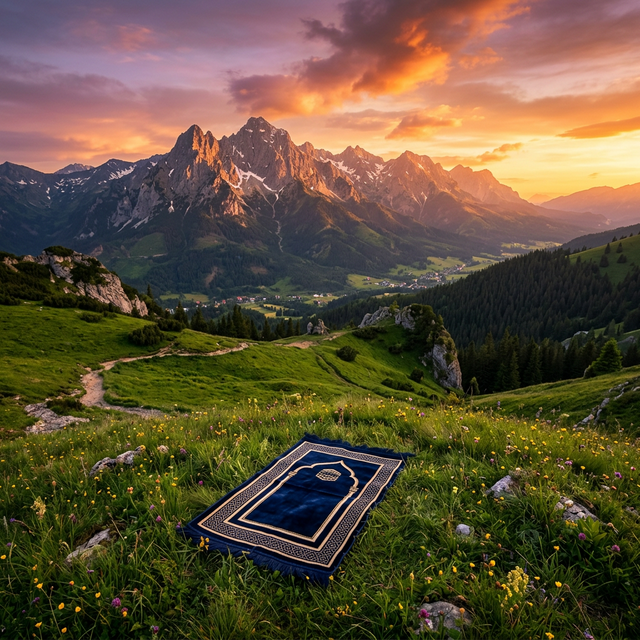
- Carry a travel prayer mat. Useful for hotels, apartments, and scenic stops on hikes.
- Big cities first for infrastructure. Warsaw and Kraków offer the most mosques, halal shops, and Islamic services.
Plan Your Halal Trip to Poland & Zakopane
If Poland is on your list, these practical guides cover everything a Muslim traveller needs for a trip to Zakopane and the Tatra Mountains: